Genome browser (v1.20.0+)
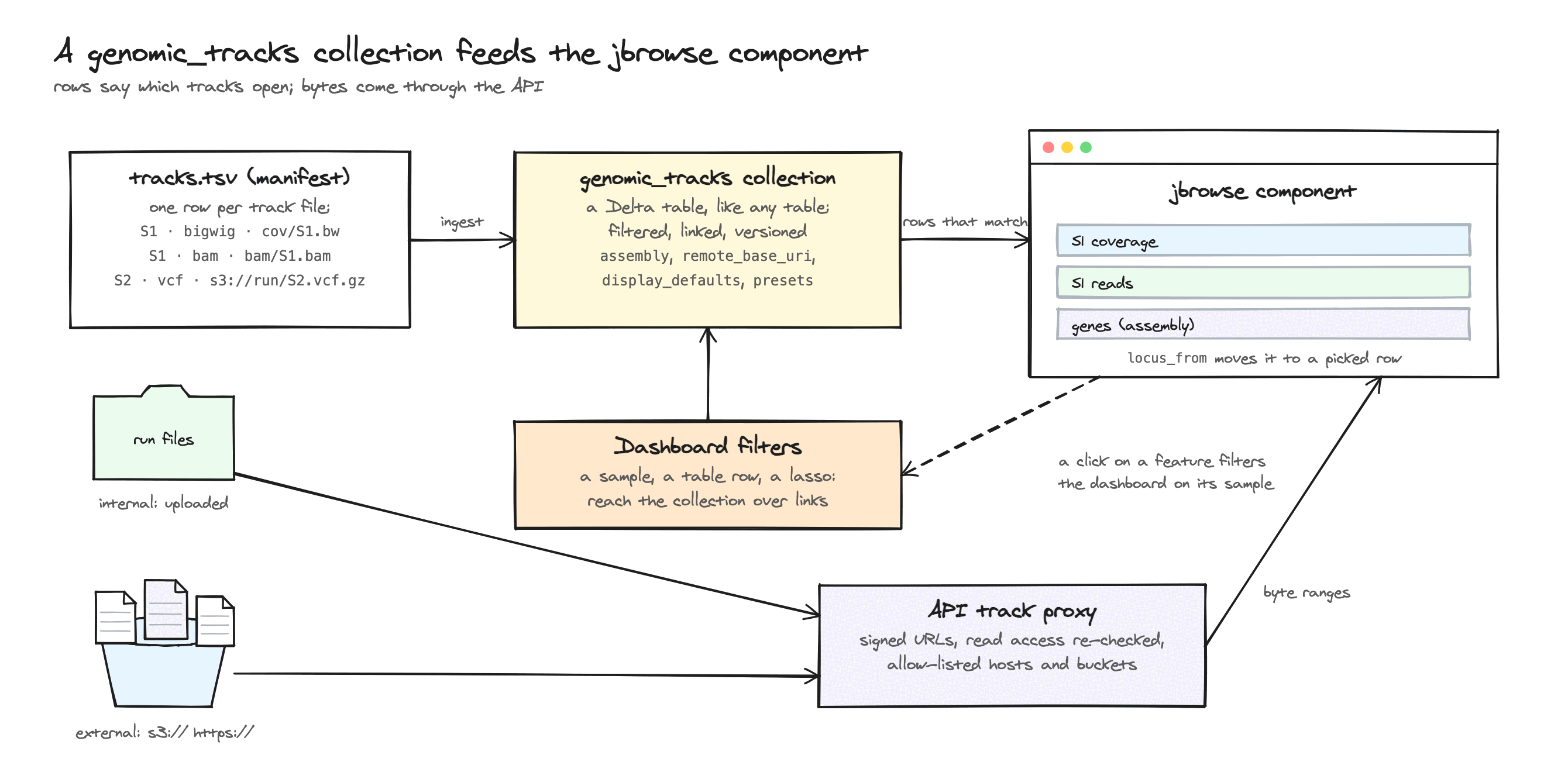
The jbrowse component shows a run's coverage, peaks, variants and alignments in an embedded
JBrowse 2 view. Dashboard filters pick the tracks and move the browser
to a picked row; a click on a feature filters the dashboard back. Nothing else has to run: the
track bytes come through the API, in depictio local up, Docker Compose and Kubernetes alike.
GenomeSpy and JBrowse together
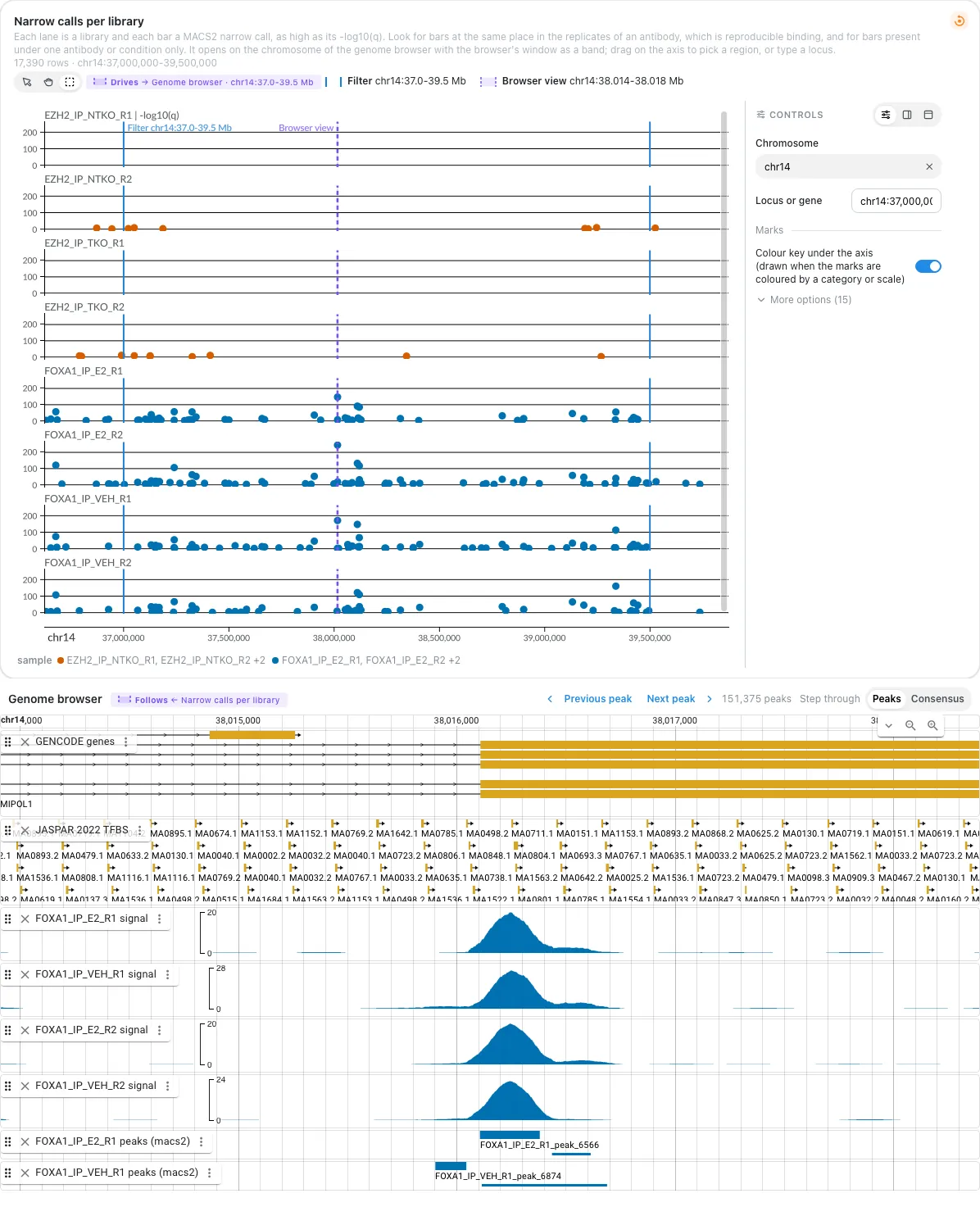
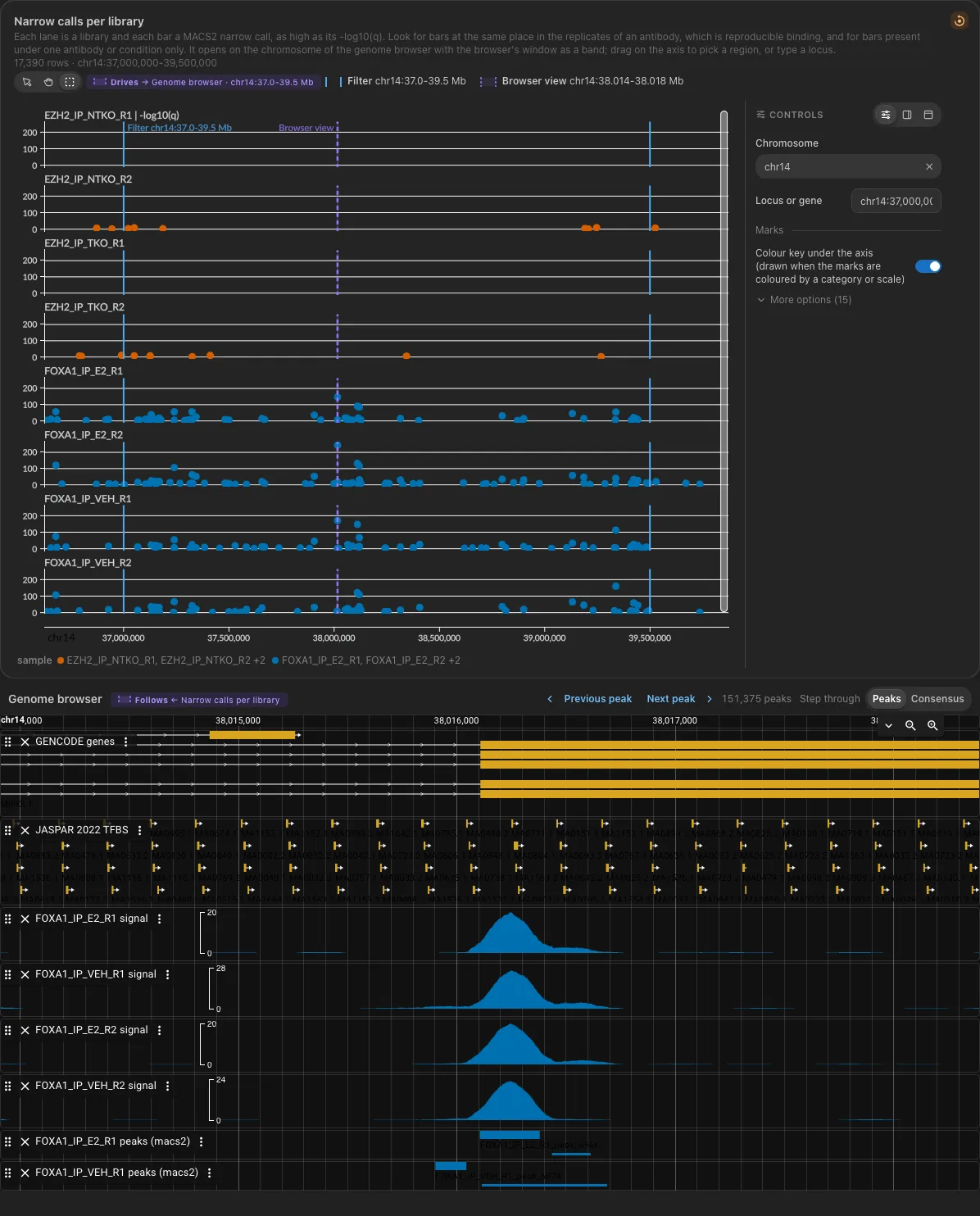
nf-core/chipseq, Locus tab: the lanes above are a genome_view tile (GenomeSpy), one dot per call on chr14:37.0-39.5 Mb, with the browser's window as a band. The jbrowse component below is open on that band.
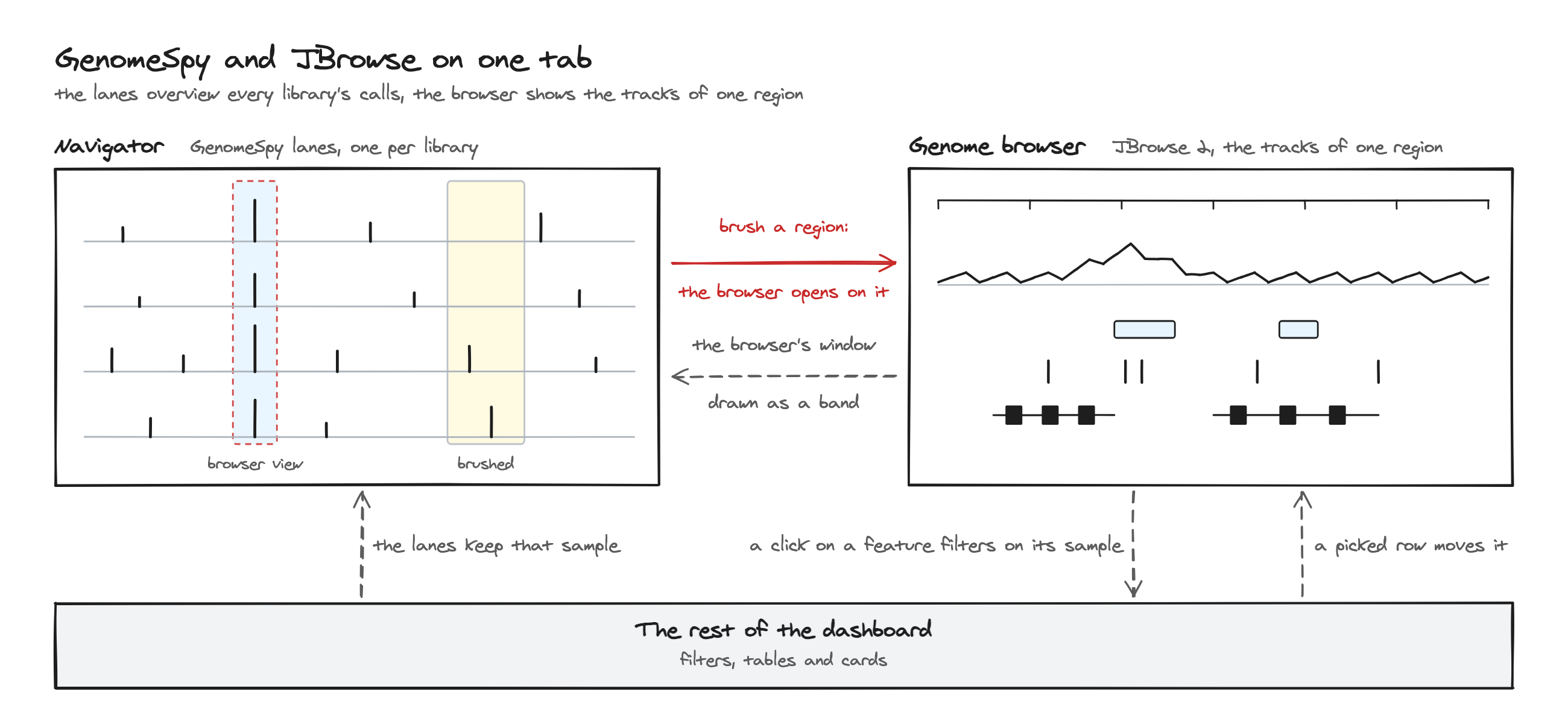
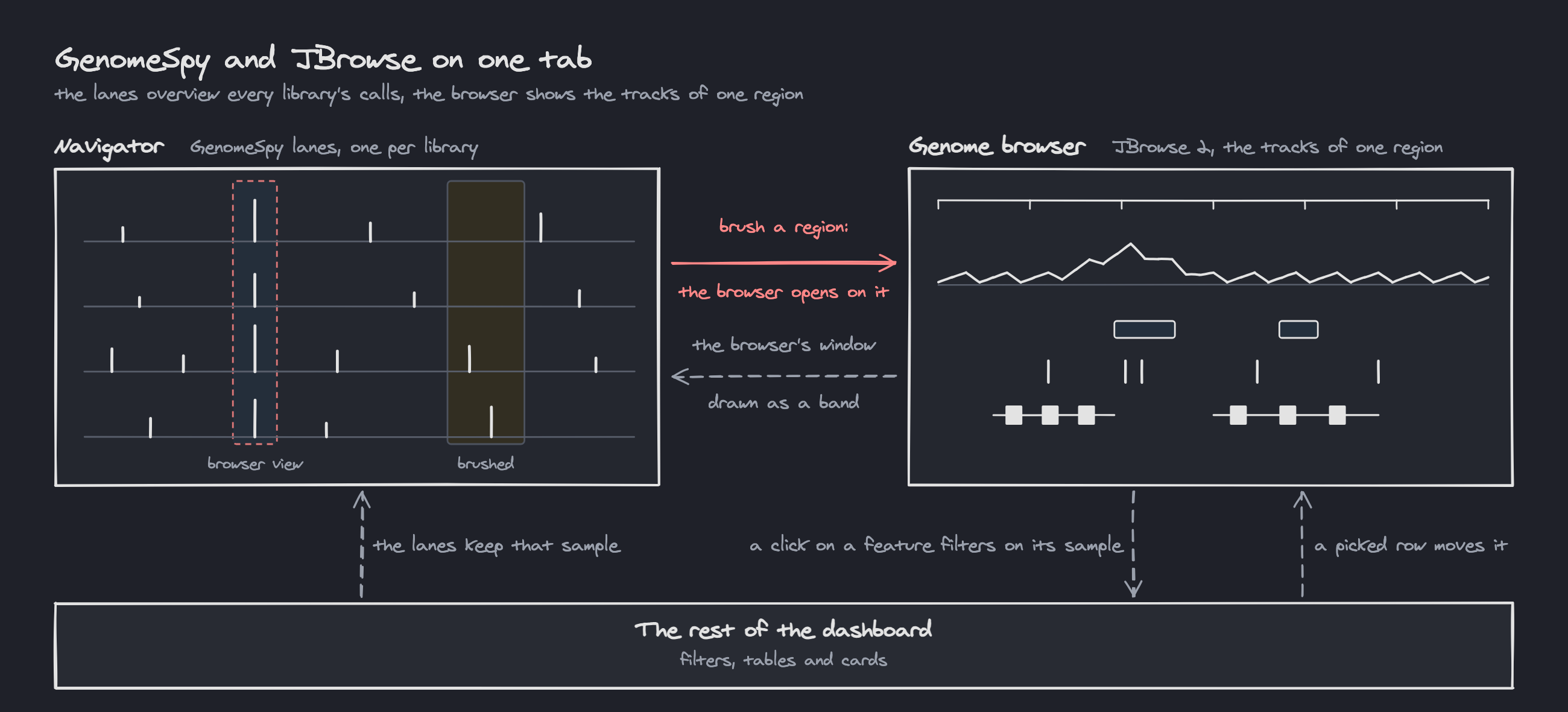
The lanes show every library's calls along the chromosome; the browser shows the tracks of one region. Each drives the other:
- Lanes to browser: brush a region on the lanes and the browser opens on it. The browser does not filter on the region, so every track stays open (Navigator).
- Browser to lanes: the browser's window is drawn as a band on every lane.
- Browser to dashboard: a click on a feature filters the dashboard on its track's sample, and the lanes keep that sample's calls (Browser to dashboard).
- Dashboard to browser: filters pick the tracks, and a picked row moves the browser (Table to browser).
Both can share one colour ramp, so a time course reads the same on the lanes and on the tracks (Time course).
Examples
Each example opens its own page: the clip, what it shows, and the few lines of YAML behind it.
-
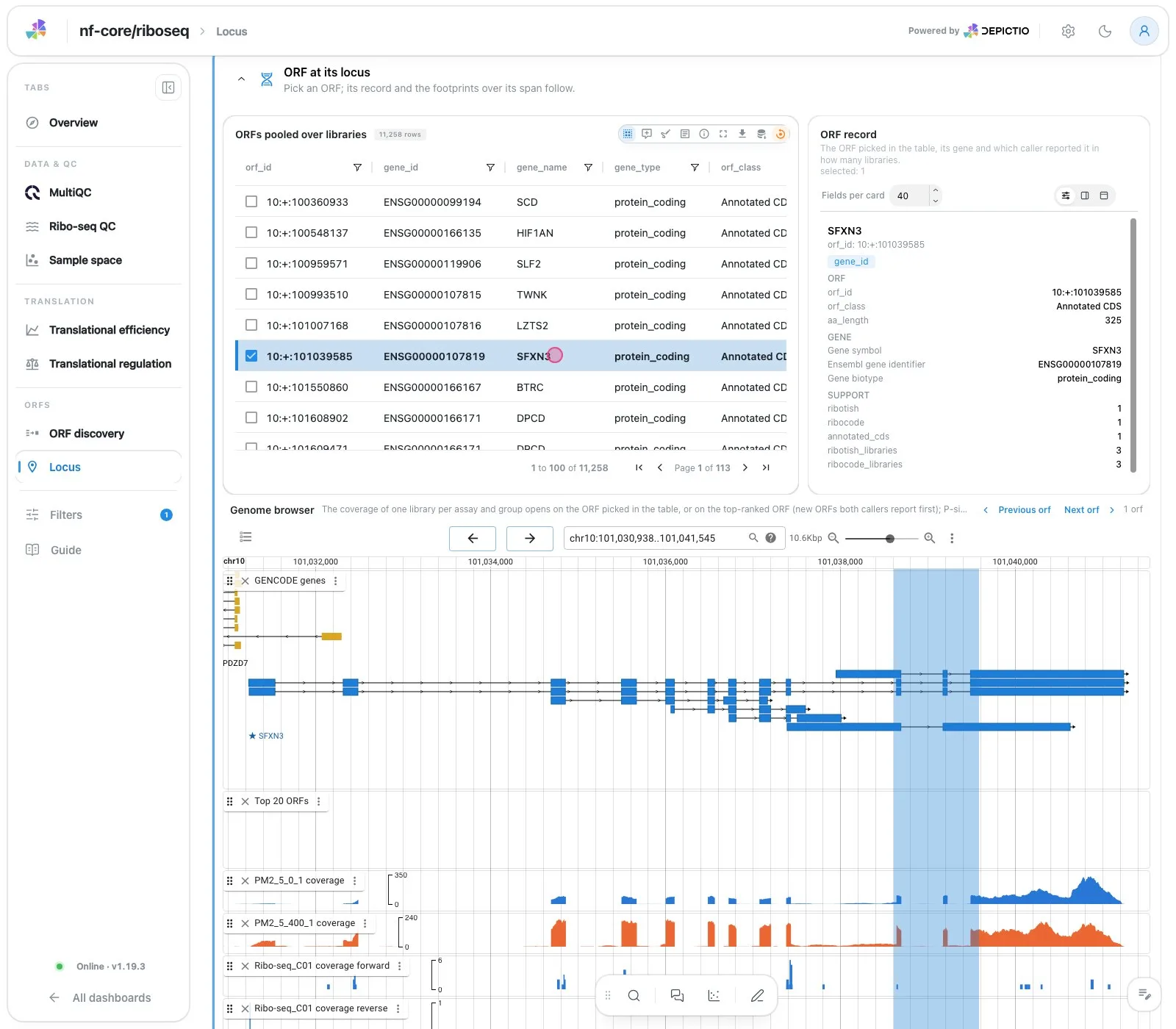
A row picked in a table frames the browser on it.
-
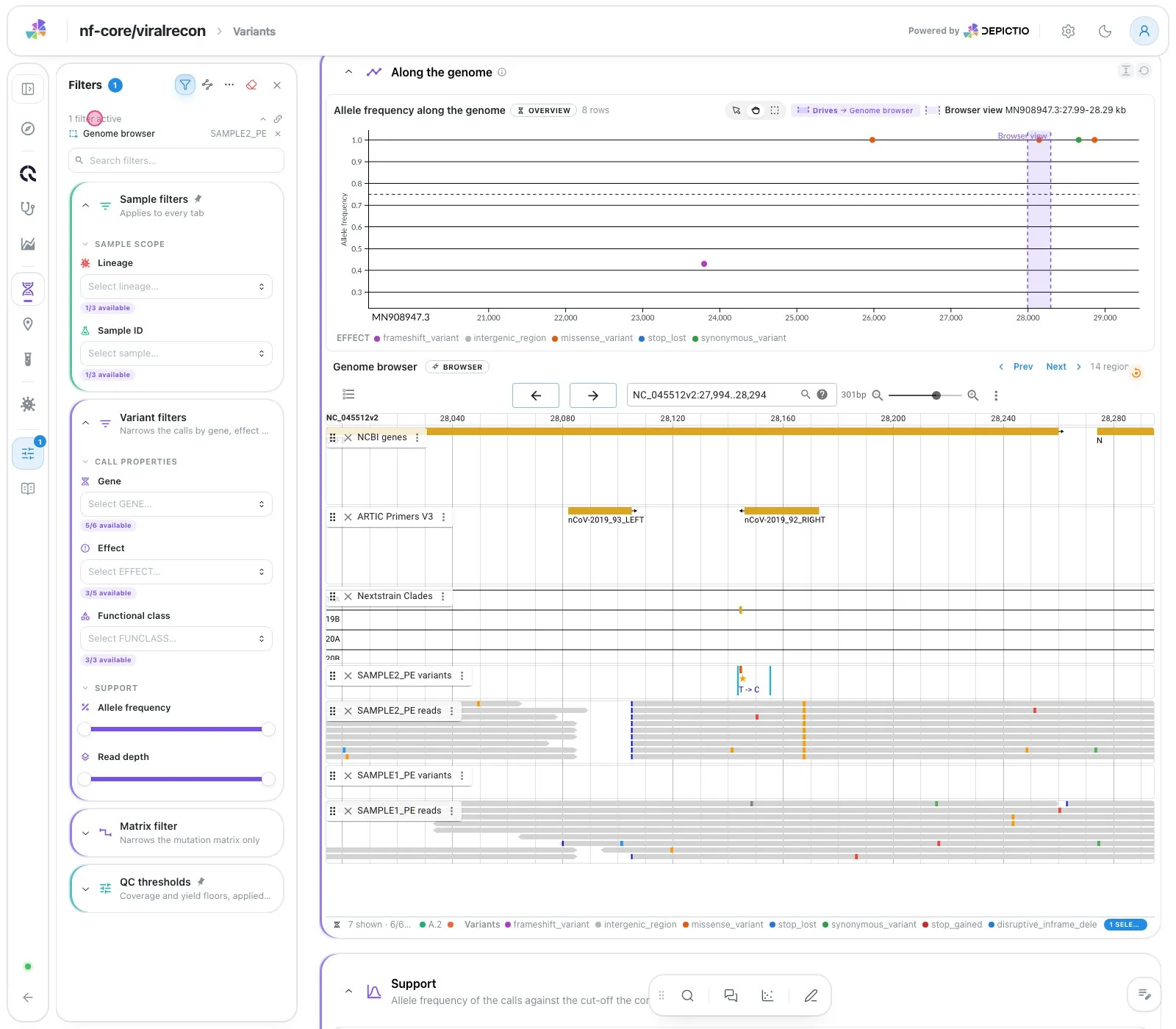
A click on a feature filters the dashboard on its sample.
-
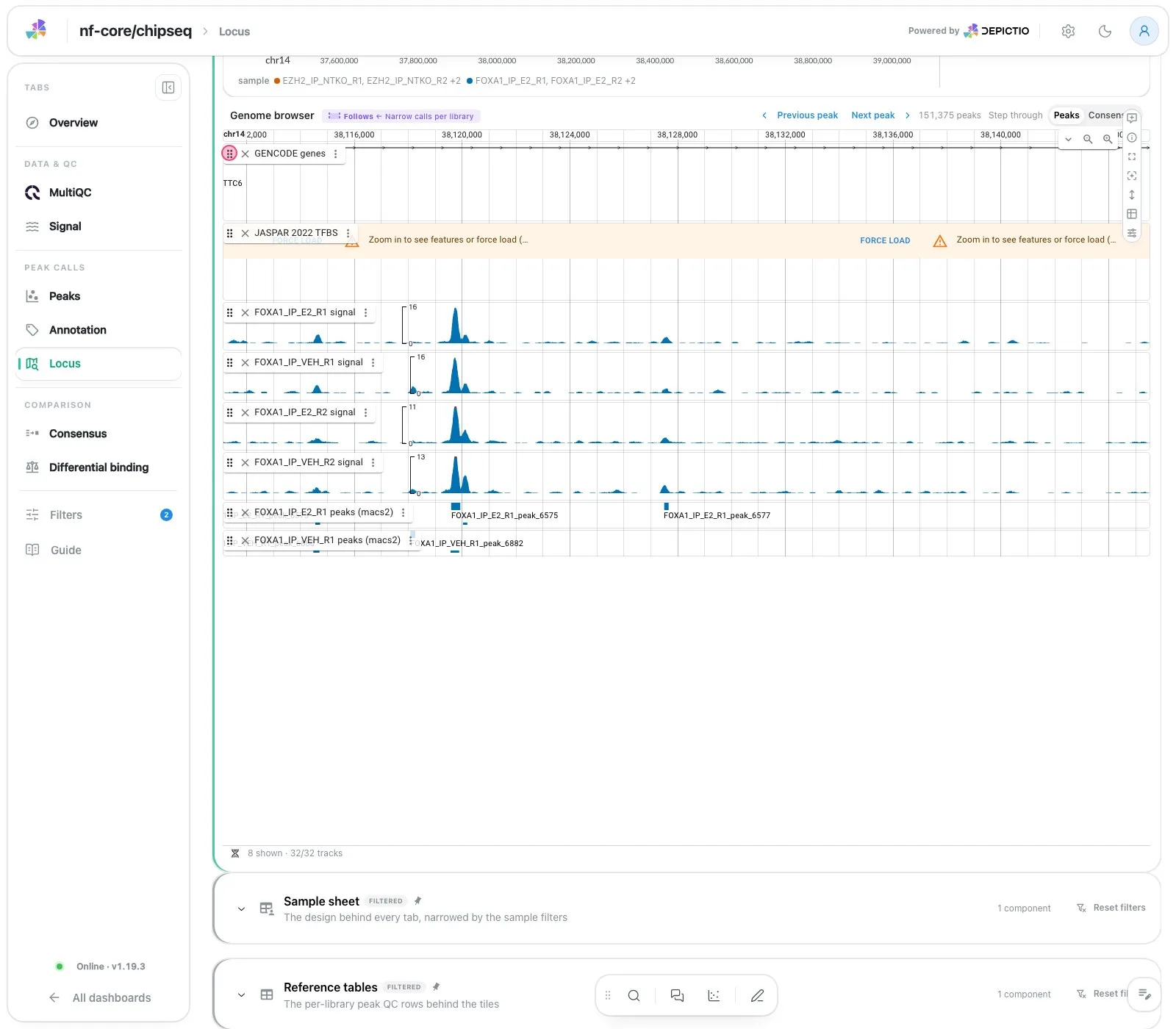
Brush a region on GenomeSpy lanes; the browser opens on it.
-
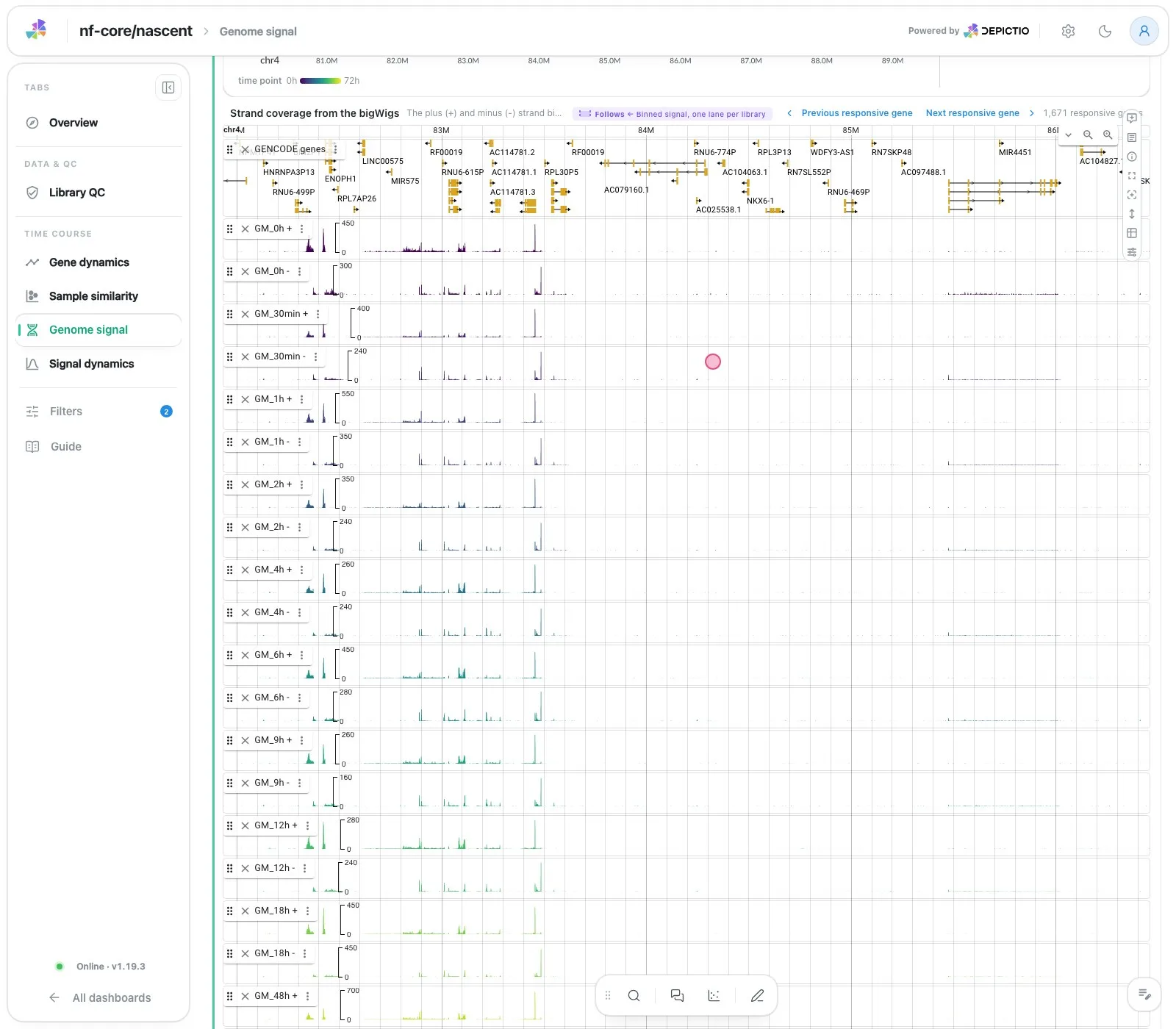
One colour ramp from the earliest library to the latest.
-
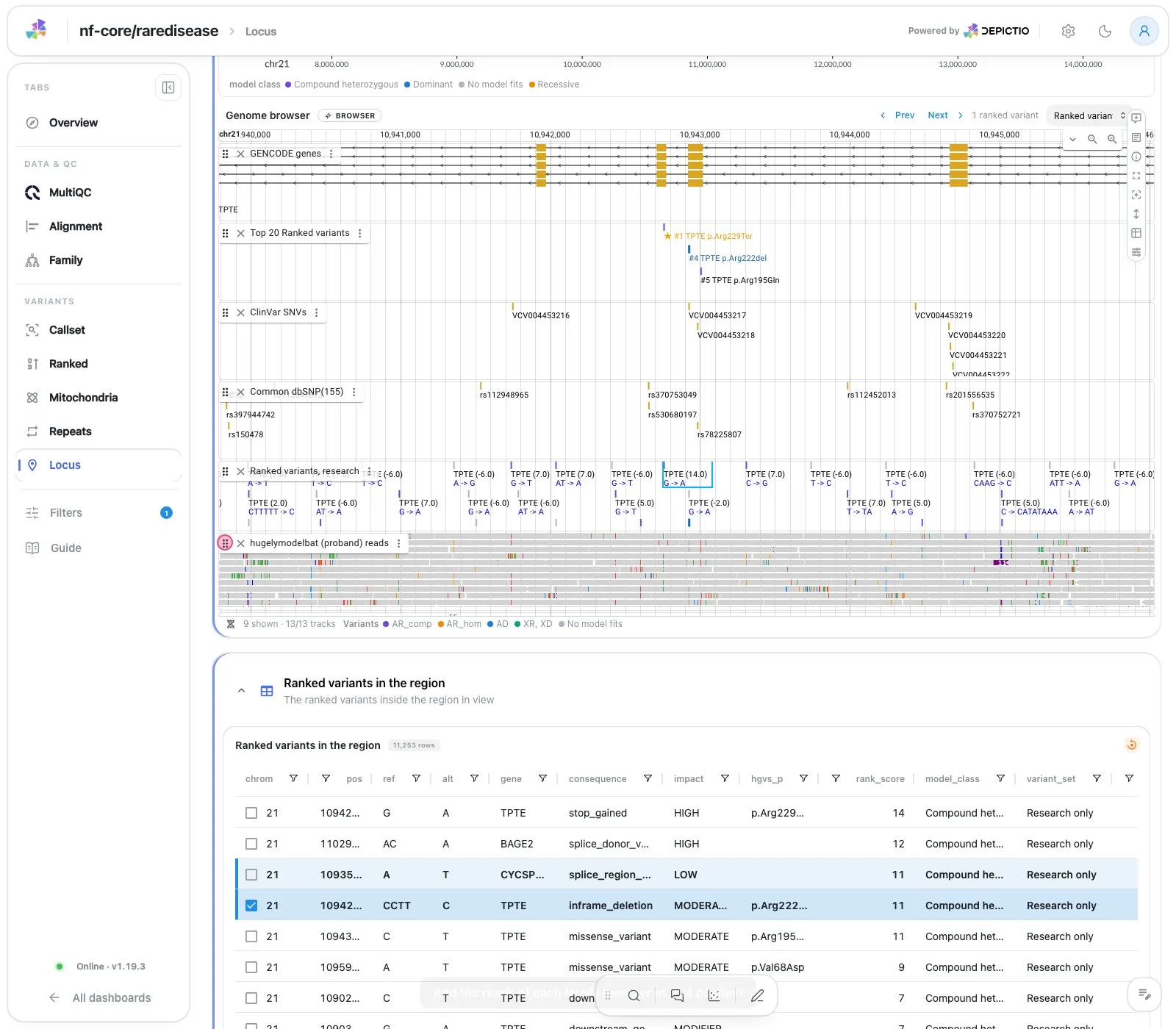
A numbered track of the best calls, picked and zoomed.
-
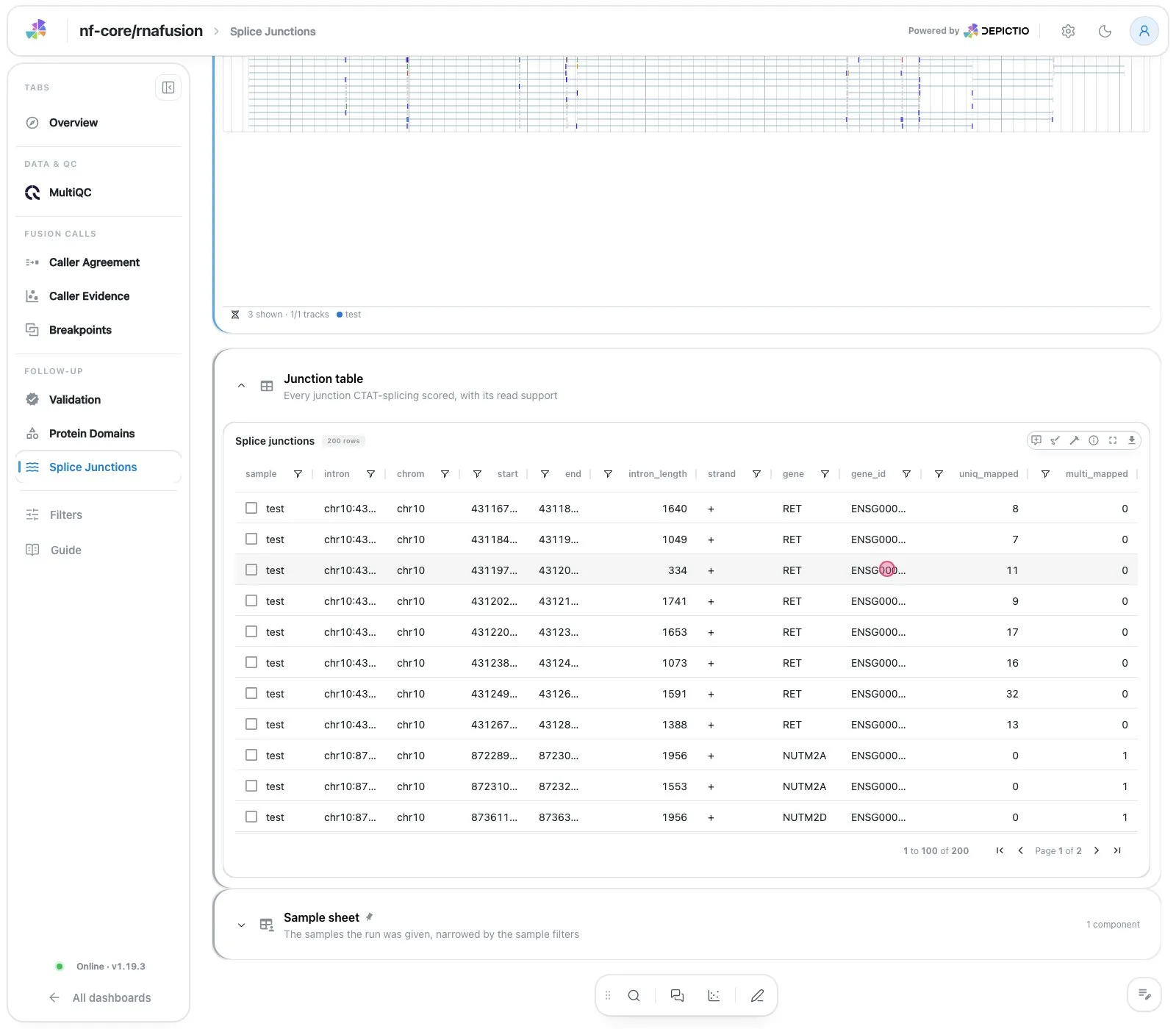
Splice junctions as arcs over RNA coverage.
-
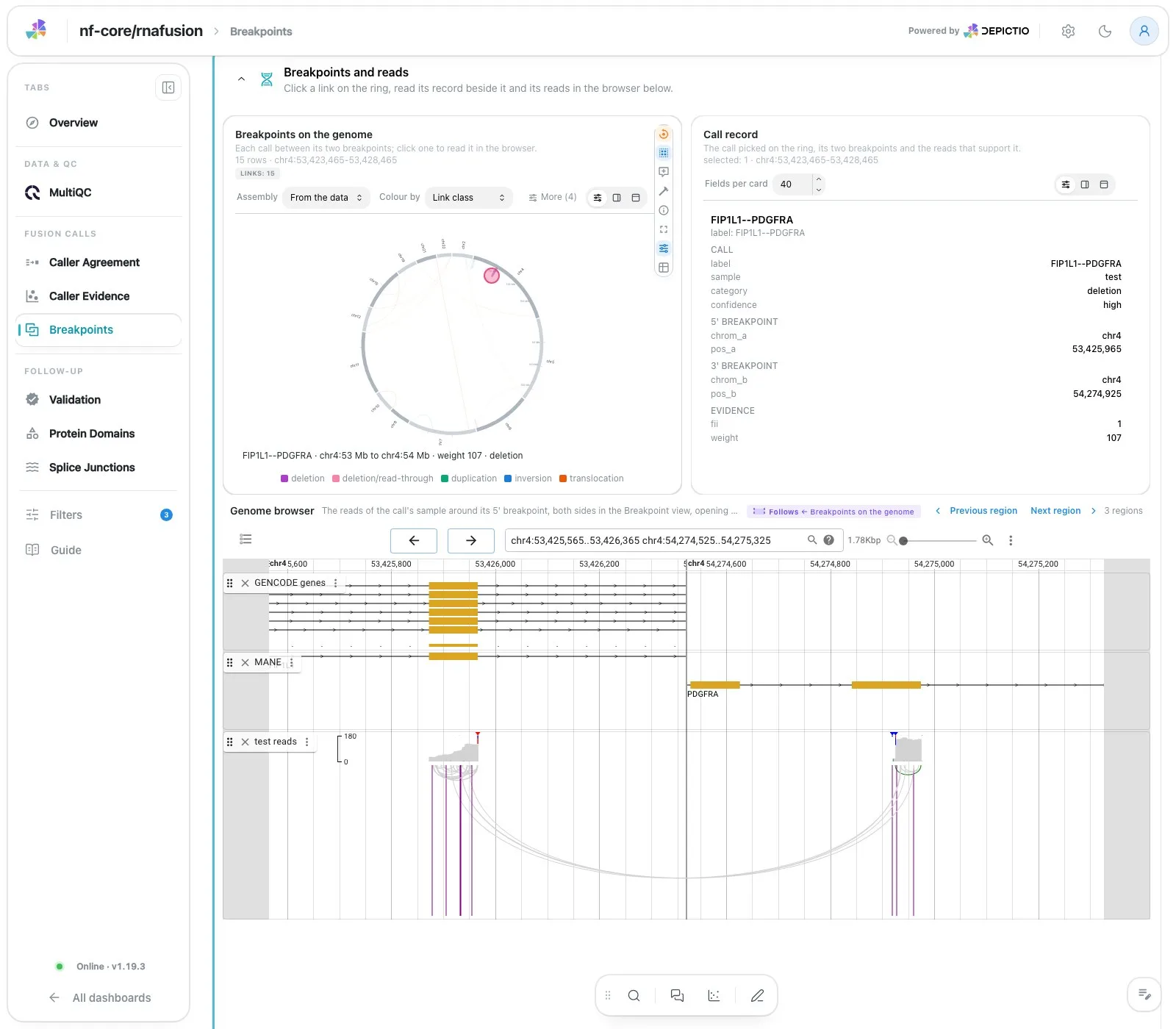
Both sides of a call, the breakpoint view and the circular view.
-
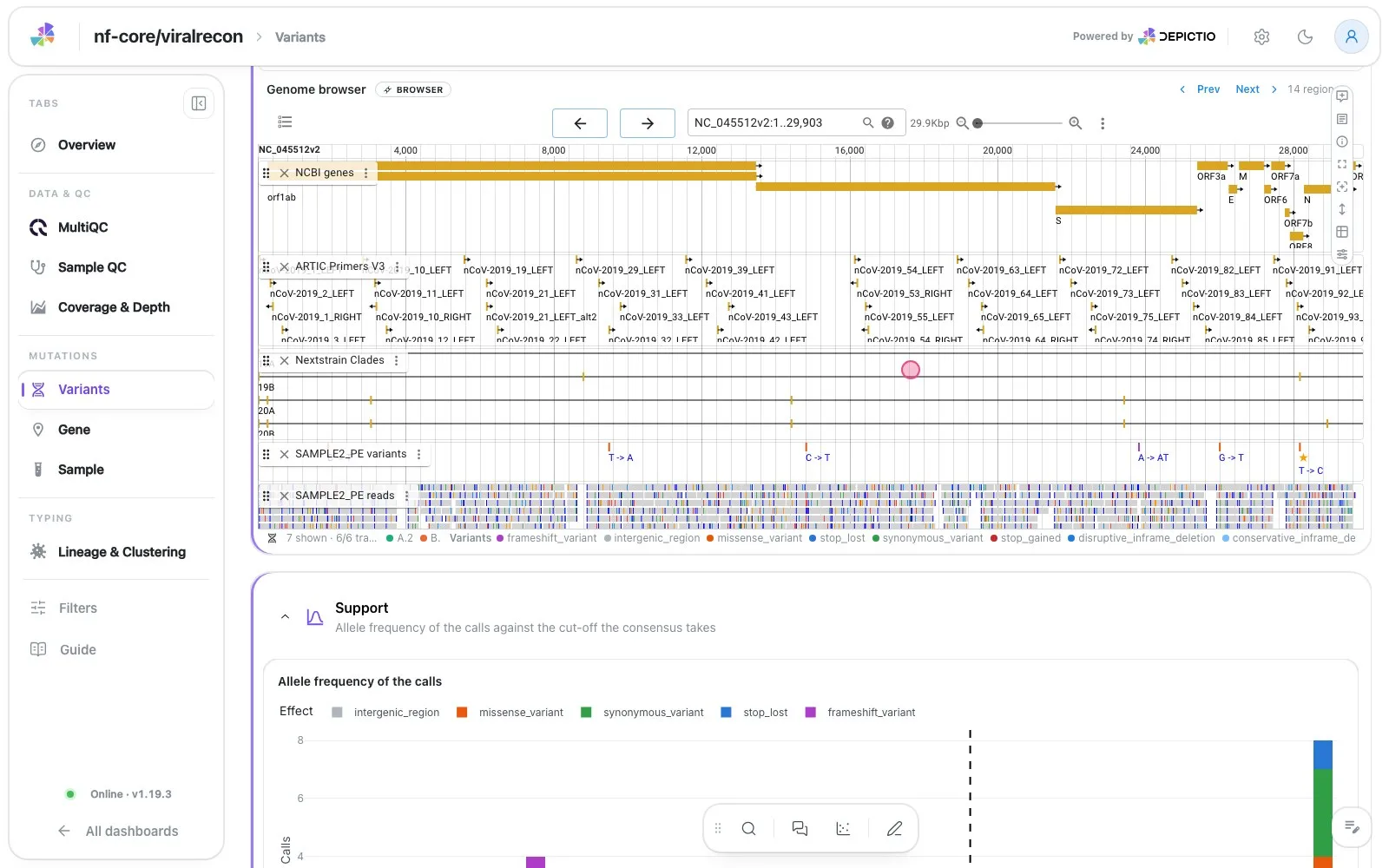
Tracks of the UCSC catalogue next to the run's own.
-
Variants coloured by a category of the dashboard.
-
Any JBrowse setting or track, merged last.
How it works
Quick start
A tracks manifest, one row per file, declared as a genomic_tracks collection of the
project, and a jbrowse component on the dashboard:
The manifest is found like any table: by the collection's scan, in the workflow's data
location, next to the run's results. Its relative paths are read from the manifest's own folder
(tracks_base_path sets another one). In the nf-core dashboard templates, a recipe writes the
manifest from the files the run published, so there is no file to write.
The genomic_tracks collection
| Key | Default | Meaning |
|---|---|---|
uri_column |
uri |
A relative path, or an s3:// or https:// URI |
sample_column |
The column tracks are filtered and selected on | |
format_column |
format |
The format, else inferred from the extension |
index_column |
index_uri |
The index, else the .tbi, .csi, .bai or .crai next to the file |
track_id_column, name_column, color_column, category_column, order_column |
Track id, label, colour, folder, opening order | |
assembly |
hg38 |
A built-in assembly or a custom one |
tracks_base_path |
the manifest's folder | Where relative paths are uploaded from |
remote_base_uri |
Where relative paths are read in place instead | |
direct_access |
false |
Let the browser fetch https:// tracks itself |
display_defaults, presets |
JBrowse configuration per format, and named fragments for preset |
Formats: bigwig, bedgraph, bed, bigbed, narrowpeak, broadpeak, vcf, bam,
cram, gff3, gtf, hic, fasta. Tabix formats need a .tbi or .csi index.
Internal and external tracks
| Track | Manifest uri |
Collection key | Read by |
|---|---|---|---|
| Internal | relative path | the API, from depictio's storage, after an upload at ingestion | |
| External, in place | relative path, or absolute s3:// / https:// |
remote_base_uri for relative paths |
the API, from an allow-listed host or bucket |
| External, from the browser | https:// |
direct_access: true |
the browser (the host must send CORS headers) |
Nothing to set: at ingestion each file is uploaded with its index under the collection's
genomic_tracks/<dc_id>/ folder, and removed with the collection or the project.
dc_specific_properties:
  remote_base_uri: s3://my-results/run-42/   # or https://data.example.org/run-42/
The server reads only what the administrator allows:
DEPICTIO_JBROWSE_REMOTE_S3_BUCKETS=my-results
DEPICTIO_JBROWSE_REMOTE_HTTPS_HOSTS=data.example.org
# a private bucket, or one outside AWS
DEPICTIO_JBROWSE_REMOTE_S3_ENDPOINT_URL=https://s3.example.org
DEPICTIO_JBROWSE_REMOTE_S3_ACCESS_KEY=...
DEPICTIO_JBROWSE_REMOTE_S3_SECRET_KEY=...
The nf-core templates take the run's results folder as a variable:
depictio run --var TRACKS_URI=s3://<bucket>/<run>/results/.
Assemblies
| Assembly | Organism | Aliases | Gene track |
|---|---|---|---|
hg38 |
Human | GRCh38 |
GENCODE |
hg19 |
Human | GRCh37 |
GENCODE |
hs1 |
Human T2T | T2T-CHM13v2.0, CHM13 |
NCBI RefSeq |
mm10 |
Mouse | GRCm38 |
GENCODE |
mm39 |
Mouse | GRCm39 |
NCBI RefSeq |
danRer11 |
Zebrafish | GRCz11 |
NCBI RefSeq |
dm6 |
Fly | BDGP6 |
NCBI RefSeq |
ce11 |
Worm | WBcel235 |
NCBI RefSeq |
sacCer3 |
Yeast | R64, R64-1-1 |
NCBI RefSeq |
TAIR10 |
Arabidopsis | araTha1 |
NCBI RefSeq |
wuhCor1 |
SARS-CoV-2 | MN908947.3, NC_045512.2 |
NCBI genes |
These are presets: the sequence, chromosome sizes, chromosome aliases and gene track of each are already wired to UCSC's files, and gene search works on them. The list covers the genomes of the nf-core test datasets; it is not a limit. Any other genome is a custom assembly of three URLs, and UCSC's GenArk hubs publish them for thousands of assemblies:
assembly:
  name: MN908947.3
  aliases: [NC_045512.2]
  twobit_uri: https://hgdownload.soe.ucsc.edu/goldenPath/wuhCor1/bigZips/wuhCor1.2bit
  chrom_sizes_uri: https://hgdownload.soe.ucsc.edu/goldenPath/wuhCor1/bigZips/wuhCor1.chrom.sizes
  refname_aliases_uri: https://hgdownload.soe.ucsc.edu/goldenPath/wuhCor1/bigZips/wuhCor1.chromAlias.txt
A custom assembly has no gene search; type a locus instead.
The jbrowse component
| Key | What it does |
|---|---|
track_mode, max_tracks, initial_tracks |
Open the filtered tracks (or all), and how many |
initial_categories, default_tracks |
Open on these track categories, or always show these tracks |
location |
The opening locus, or a gene name |
locus_from |
Follow the filtered rows of another collection |
selection_enabled, selection_column, selection_mode |
Filter the dashboard from the browser |
color_by, color_scale, variant_color_by |
Colour tracks by a column, along a ramp, or variants by a category |
ucsc_tracks, show_annotation |
UCSC Genome Browser tracks, the assembly's gene track |
show_junctions, read_pairs_display |
Sashimi arcs; DNA reads as pileup, arcs or cloud |
views |
breakpoint and circular views |
display, preset, config_overrides |
Display defaults, a configuration preset, raw JBrowse configuration |
fetch_size_limit_mb, force_load |
The per-track download limit, lifted or not |
placement |
grid, or floating to keep the browser on screen across tabs |
The component builder has a Genome browser type with the same settings.
Versions and security
- A version preview or a dataset pin reads the manifest at its pinned commit. The track files are not versioned.
- The browser never receives a storage URL or credentials: tracks come through signed proxy URLs (6 hours), the proxy re-checks read access, and clients name tracks by id, never by URL.
- External files are read only from allow-listed hosts and buckets;
http://is refused and redirects are not followed. DEPICTIO_JBROWSE_ENABLED=falseturns the browser off. EveryDEPICTIO_JBROWSE_*variable is in the environment reference.
Templates with a genome browser
| Dashboard template | Tab |
|---|---|
| nf-core/atacseq 1.2.2 | Locus |
| nf-core/chipseq 1.2.0 | Locus |
| nf-core/cutandrun 3.1 | Locus |
| nf-core/drop 1.0.0 | Locus |
| nf-core/nanoseq 3.0.0 | Locus |
| nf-core/nascent 2.3.0 | Genome signal |
| nf-core/oncoanalyser 3.0.0 | Small variants, Structural variants |
| nf-core/raredisease 3.1.2 | Locus |
| nf-core/riboseq 2.0.0 | Locus |
| nf-core/rnafusion 4.1.3 | Breakpoints, Splice Junctions |
| nf-core/rnaseq 3.26.0 | Gene Explorer |
| nf-core/rnasplice 1.0.4 | Splicing Events |
| nf-core/rnavar 1.3.0 | Genome |
| nf-core/sarek 3.10.0, 3.11.0 | Locus |
| nf-core/variantbenchmarking 1.4.0 | Germline, Structural & CNV |
| nf-core/viralrecon 3.0.0 | Variants |
Limits
- Track data is parsed on the page's main thread: fine for tens of open tracks. A view carries at most 500.
- Large unindexed BED and bedGraph files are refused:
bgzipandtabixthem. - No browser in the nf-core/methylseq template (unindexed bedGraphs) or nf-core/hic (a
.hicmap needs a Hi-C display).